
Expanding Our Focus
From what is good for us to what is good for the world.
Have you heard of the Blue Zones? I first encountered this idea when I was studying nutrition and wellness at the Institute for Integrative Nutrition over a decade ago. Coined by Dan Buettner, the “blue zones” are areas in the world where people regularly live to be over a hundred years old and retain a high quality of life well into their old age. Mr. Buettner set out to understand why, and whether by applying those principles elsewhere, the results could be replicated.
With a team of researchers, Buettner discovered nine habits that were shared by nearly all the blue zone locations, from Japan, to Costa Rica, to Italy. These habits include what one might expect: eat more plant-based meals, move naturally and regularly, know your purpose, decrease stress, have a community, etc.
But this article isn’t actually about the blue zones; it’s about what I think is missing from this entire paradigm.
And that is the greater, more-than-human, natural world of which we are a part.
It is high time that we shift, or at the very least expand, our definition of who is worthy of quality of life. (And the “who” in that sentence is carrying a lot more weight than simply human beings.)
What if, rather than focusing solely on human longevity, we looked at the health, vibrancy, and diversity of the communities and ecosystems to which we belong?
Research has shown that humans thrive when our world thrives. It makes complete sense, given how interwoven we are to all the creatures and plants and waterways and soil and air. This interconnection is what makes life itself possible. And yet somehow, we have forgotten this basic fact.
Some seem to expect that with technology alone, humans can be happier, healthier, and more fulfilled, even if the wild world around us is paved over in concrete, species are going extinct, and the oceans are being poisoned with agricultural runoff. As if that doesn’t hurt us, also. As if we were somehow separate and immune. Of course, it negatively affects us physically, but it also engenders a deeper and different kind of hurt: it wounds the soul. We become less alive, less able to feel and sense and respond to the world around us. Though it is not always consciously acknowledged, this wound is painful, so we further retract or distract or numb until we become even less alive, and on and on the cycle goes. Is it any wonder that one of the main sentiments of our time seems to be “I don’t care”?
In his essay, A Native Hill, Wendell Berry writes:
“We have lived by the assumption that what was good for us would be good for the world. [...] We have been wrong. We must change our lives, so that it will be possible to live by the contrary assumption that what is good for the world will be good for us. And that requires that we make the effort to know the world and to learn what is good for it. We must learn to cooperate in its processes, and to yield to its limits. But even more important, we must learn to acknowledge that the creation is full of mystery; we will never entirely understand it. We must abandon arrogance and stand in awe. We must recover the sense of the majesty of creation, and the ability to be worshipful in its presence. For I do not doubt that it is only on the condition of humility and reverence before the world that our species will be able to remain in it.”
What happens when we begin to live by this contrary assumption, that what is good for the world will be good for us? How does it shift our choices and perspective? How might it change where we devote our precious energy and time?
How does it transform who we become and how we steward the world that is in our guardianship?
There is much focus on self-care in our culture, and for some good reasons (others of which are more consumerist in nature…). Many of us are chronically anxious, tight, stressed, and bordering on burnout. Adding more to our plate of care seems counterintuitive when we feel close to a breaking point already.
But as Sue Stuart-Smith writes in The Well-Gardened Mind: The Restorative Power of Nature:
“The contemporary emphasis on self-improvement and self-investment can make care seem like a depleting activity because it requires putting in effort for something other than ourselves, but the neurochemistry of care is not like that. For obvious evolutionary reasons, care has inbuilt neurochemical rewards. The feelings of calm and contentment that accompany nurture have benefits for the giver and receiver alike [...].”
We are made to care for the world that exists outside of us and all the living beings that make up that world. By expanding our focus, we too organically begin to feel more whole and at peace.
When we nurture the land and the plants and the animals and one another, we become more human in the process. We reclaim our own innate creatureliness. Connection and care were never meant to be depleting; they were meant to make life worth living.
What might this shift of focus look like in real life? I am currently reading We Are The Ark: Returning Our Gardens to Their True Nature Through Acts of Restorative Kindness. In it, author Mary Reynolds provides many potential ideas for how our gardens and outdoor areas of all sizes (ranging from several acres to a single window box) can become a restorative act of kindness towards the earth.
Here in the ‘burbs, these are some things we are putting into practice:
Planting more Texas natives. Not only are native plants more accustomed to the crazy temperature ranges and drought periods we experience here in North Texas, but they also evolved within this particular ecosystem. This means that they support native insects and creatures in ways that other non-native plants may not. Our perennial gardens include Gregg’s Mistflower (beloved by butterflies, particularly monarchs who are passing through on their migration south), Turk’s Cap, and Texas Lantana. Over the coming years, we plan to convert some of our front yard to native plants and grasses, as well.
Letting perennials hang out over winter. Instead of cutting back perennials in the winter, we leave them as nesting sites for insects and critters during the colder months.
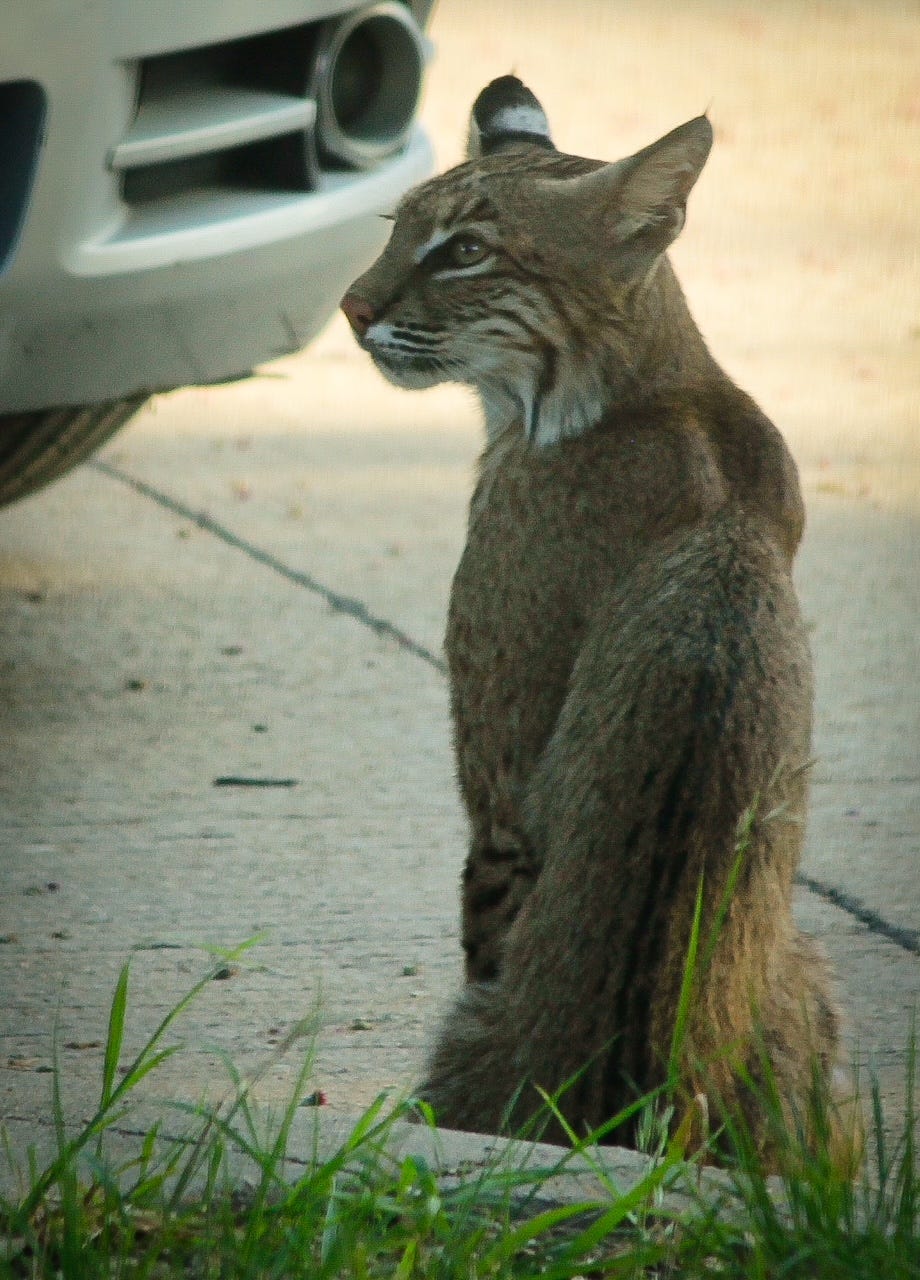
Putting out water. We have a dish that we leave out with fresh water for the birds and squirrels and bobcats and such.
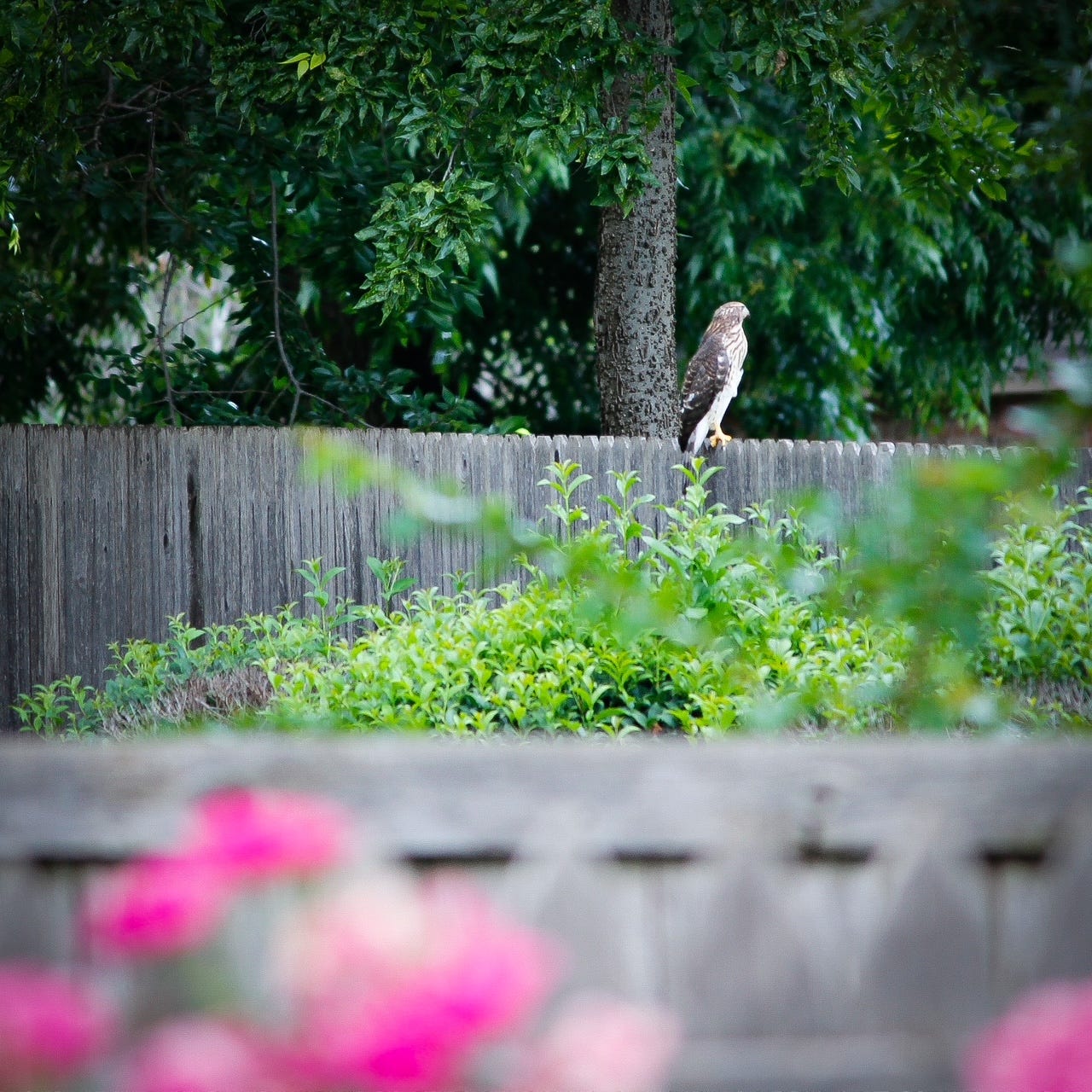
Having a variety of different sized plants. From ground cover to perennials to shrubs to big live oak and cottonwood trees, I have seen how different creatures have varying preferences. The female Yaupon Holly is a favorite of the flocks of Cedar Waxwings that come through in the winter to feast on her berries (and we have hopefully found a sustainable solution to keep their tipsy tushes from flying into our big living room window after having one too many fermented berry…). Cardinals love to build their nests in brambly, bushy shrubs. The squirrels, crows, and hawks prefer the bigger trees, especially the cottonwood in the corner of the yard.
I am certain that as I continue down this path I will continue to learn more ways to live in support of, and communion with, the natural world around me.
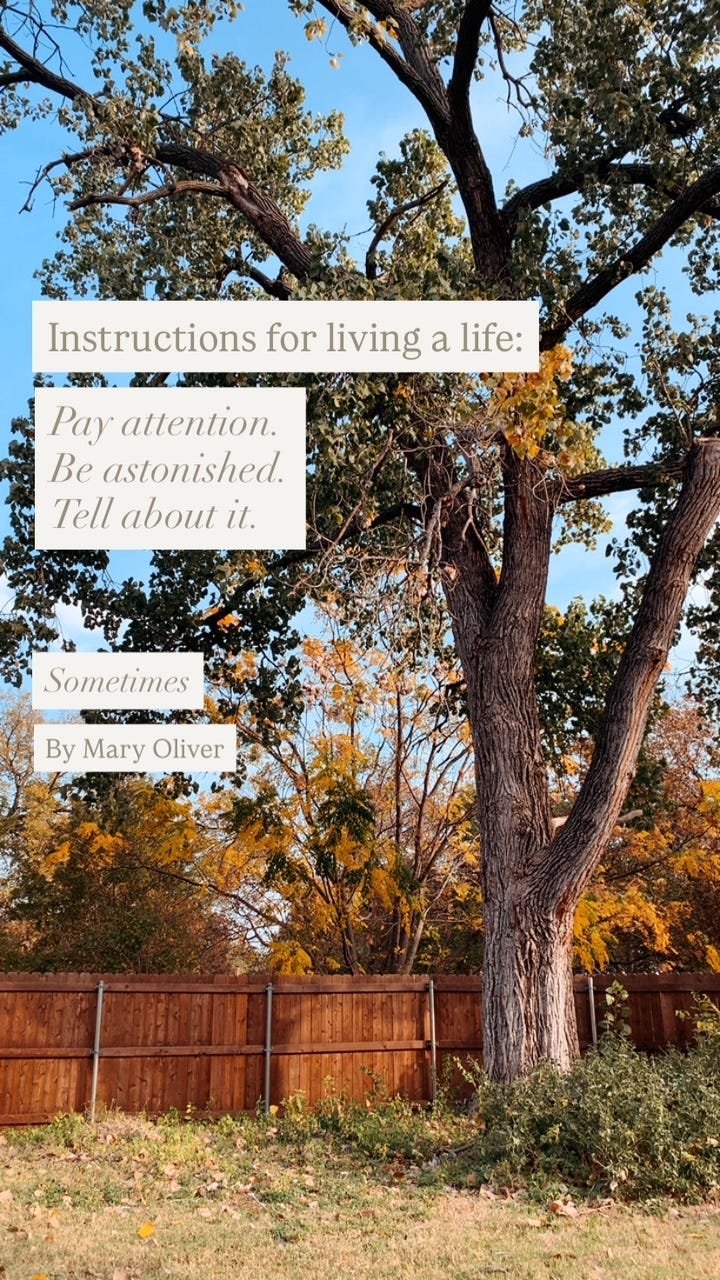
And as much as reading books or seeking out teachers has been a helpful starting point, I feel like the most important lessons I have learned have come from paying attention. Noticing the creatures and plants around me, slowly beginning to understand what their needs and preferences are, and how they dance with one another.
There was a time when what they needed to thrive here already existed. The plants and the animals and the waterways had grown and evolved together over thousands of years, creating symbiotic relationships. But now, so much of this land has been altered by man, for our sole benefit and to the detriment of the many other living beings with whom we share space. Thus, we need to consciously put back what was taken, as an offering to the wild and the world we all share.
So that we, as human beings, may remember to reweave ourselves back into the greater story of our earth’s unfolding.
With love,
Linda